Material Choice in Renovation
Accounting for the thermal performance of our built environment is essential for ensuring the safety and comfort of our homes. A critical first step in this process is understanding the materials we build with—and how they behave.
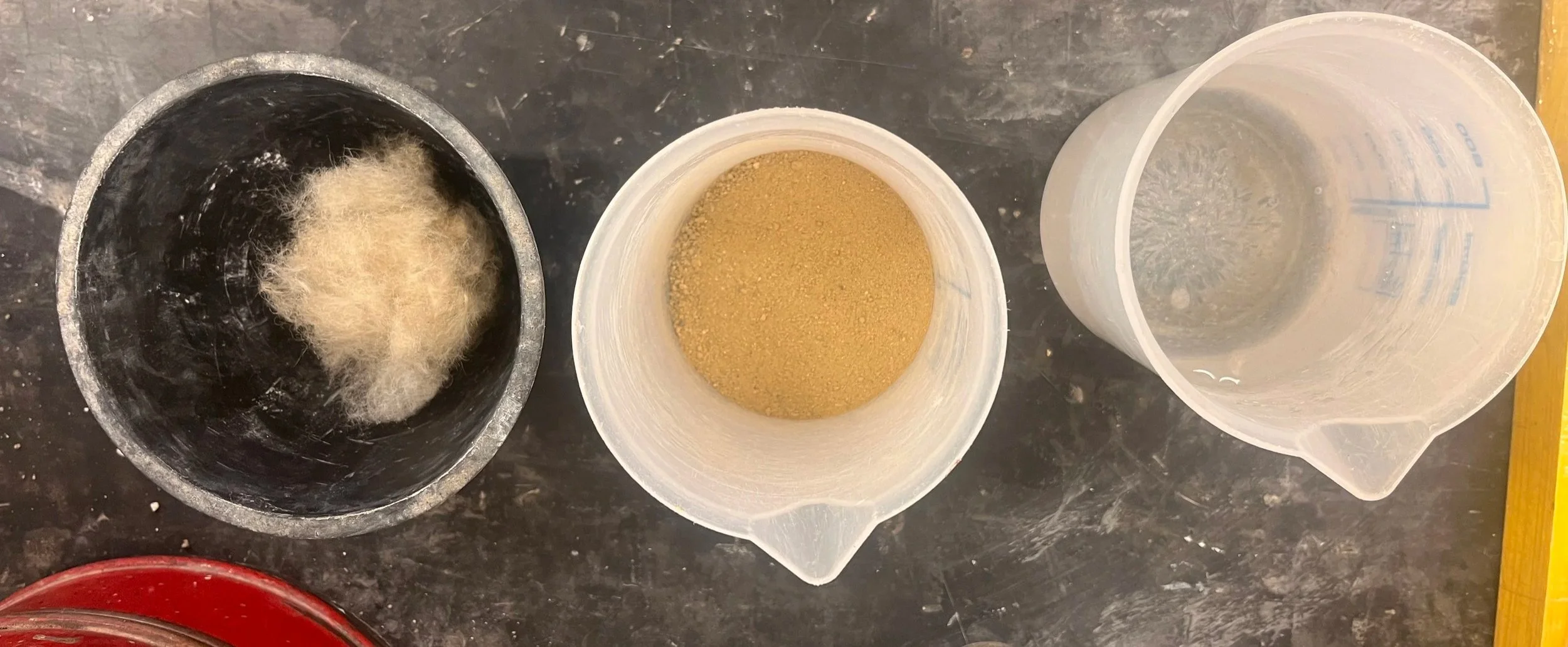
During my master’s thesis, I tested a series of fibre–clay composites to evaluate their thermal properties. Among the samples, the lowest-performing material in terms of insulation was a composite made of 20% clay and cardboard fibres, with a thermal conductivity of 0.1 W/mK. In contrast, pure clay samples showed a significantly higher conductivity of 0.37 W/mK.
To put this into context, conventional building materials tend to perform even less favourably: fired bricks typically range between 0.5 and 1.5 W/mK, while cement can vary from 0.6 up to 3.31 W/mK. These wide ranges reflect differences in composition, density, and porosity—factors that strongly influence thermal behaviour.
In the case of the BASIS Vinschgau renovation project, the existing structure consists of a 30 cm thick mixed masonry wall composed of fired bricks and mortar. Its overall thermal conductivity is estimated to fall between 0.8 and 1.6 W/mK. While such a wall can act as valuable thermal mass—absorbing and slowly releasing heat—this benefit comes at an energy cost. Maintaining indoor comfort requires sustained heating input, and without insulation, much of this energy is lost.
Introducing additional insulation layers can significantly reduce this energy demand, improving both efficiency and long-term sustainability.
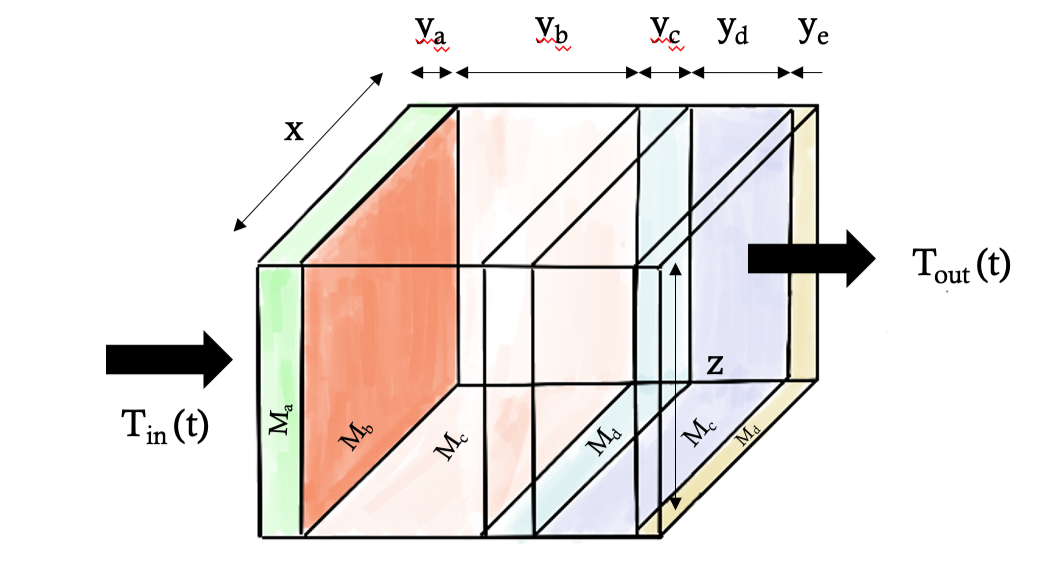
To understand this more precisely, it is important to recognize that a wall is not a single material, but a layered system. Each layer has its own thermal conductivity, and the overall performance must be calculated using a series equation that accounts for each component. The image below illustrates this principle.
Natural materials such as sheep wool, hemp, cardboard fibres, and even leaf litter have increasingly been explored as alternative insulation options. The challenge, however, lies in identifying the right material for a specific project context.
During my master’s thesis, I focused on materials available in close proximity to the renovation site, prioritising agricultural and industrial waste streams. Working with these materials introduced a high degree of uncertainty: availability can fluctuate, properties are often non-standardised, and regulatory frameworks can make their application difficult.
Despite these challenges, I was able to identify suitable materials within a 265 km radius of the site. This highlights an important opportunity—repurposing local waste streams can generate circular benefits for both ecosystems and regional economies.
The fibre materials I tested included rice husks, cardboard fibres, and sheep wool, each with distinct strengths and limitations. Rice husks, when combined with clay, proved difficult to stabilize. At higher concentrations (20%), the composite became brittle and crumbled, indicating that an alternative binder would be necessary to achieve sufficient strength while maintaining porosity.
Cardboard fibres at 20% showed more promising thermal performance, but also exhibited noticeable shrinkage during drying—an issue that requires further investigation.
Sheep wool presented a different set of behaviours. At higher concentrations (20%), the material similarly lacked structural stability, again suggesting the need for a different binding strategy. However, at low dosages (1%), sheep wool fibres improved the tensile strength of the clay, enhancing the toughness and crack resistance of the plaster.
Overall, working with local waste and natural materials can be complex and unpredictable. Yet, these challenges do not make their use unfeasible. On the contrary, targeted research can help identify gaps in existing supply chains and support the development of new material pathways—ones that are both environmentally and economically beneficial.